
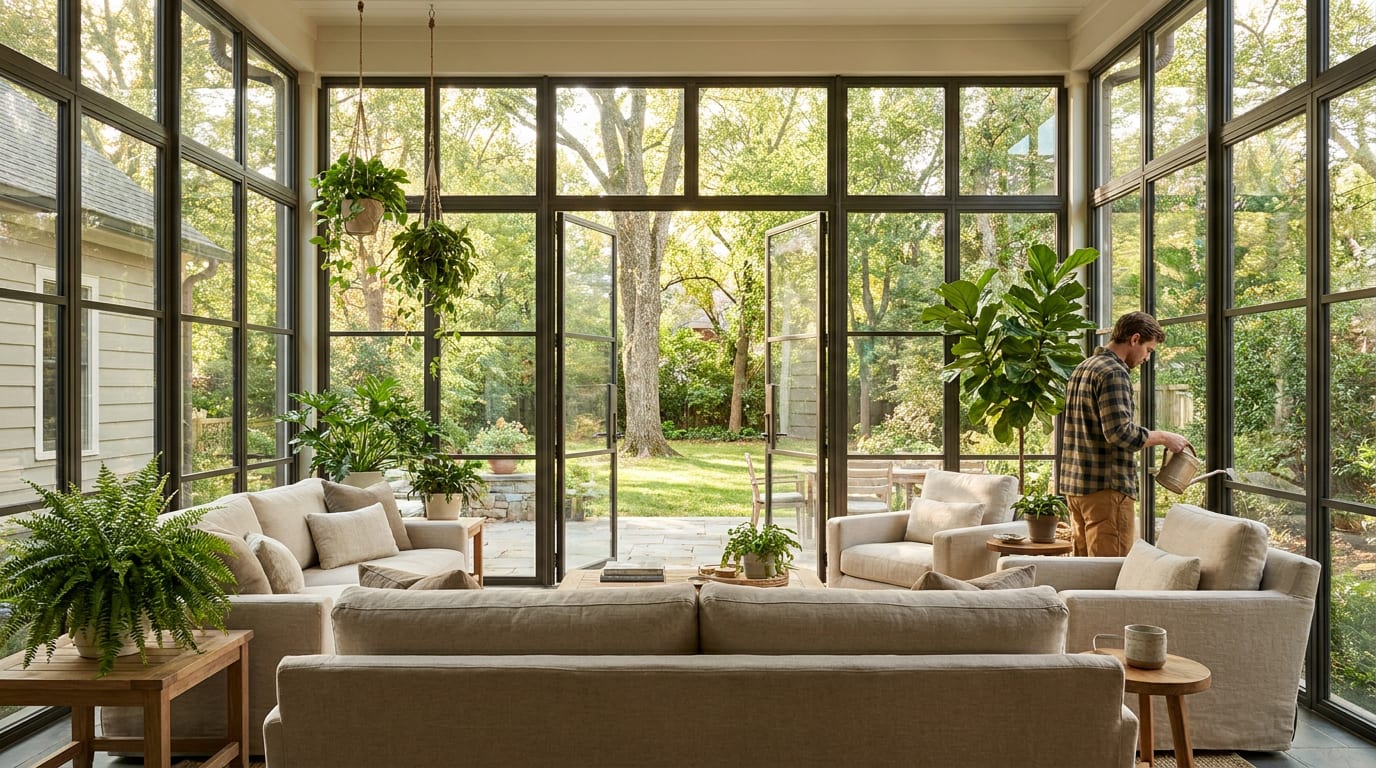
· by Michael Blair, Nashville's Sunrooms
A sunroom that is too hot in July and too cold in January is a sunroom nobody sits in. The instinct is to run a duct from the existing system into it, which is cheap on paper and is the reason many sunrooms end up uncomfortable and the rest of the house with them.
Why does extending the house system go wrong?
A central system was sized for the house it was installed in. Adding a room adds load without adding capacity, and the result is a system that runs longer to satisfy a thermostat located somewhere else entirely. Every other room drifts while the sunroom slowly catches up.
A sunroom is also a thermally extreme room. Large glass areas gain and lose heat at a rate no bedroom does, and its demand at three in the afternoon in August bears no relation to what the rest of the house is asking for. One thermostat cannot serve both, which is a zoning problem rather than a capacity one.
What does a mini split do differently?
A ductless mini split is an independent system for that room: an outdoor condenser, an indoor head, and a small line set through the wall. It has its own thermostat and its own capacity, so heating the sunroom on a January morning does not involve the rest of the house at all.
They modulate rather than cycling on and off, which suits a room whose load swings widely across a single afternoon. Modern units are also heat pumps, so the same box heats and cools, and in Middle Tennessee winters a heat pump operates in its efficient range most of the season.
Sizing, and why bigger is worse
Sunroom load is dominated by glass: how much, which direction it faces, and what the glazing is. A west-facing wall of single glazing in Nashville in August is an enormous afternoon gain, and a north-facing room with low-emissivity double glazing is a different calculation entirely.
Oversizing is the common error. A unit with too much capacity satisfies the thermostat quickly, shuts off, and never runs long enough to remove humidity, which produces a room that is cold and clammy at once. In this climate the dehumidification matters as much as the temperature, and it only happens during sustained runtime.
- Size from the glass area and orientation, not the floor area
- Oversized units leave the room cold and damp
- A heat pump head covers both seasons in Middle Tennessee
- Condensate has to drain somewhere sensible
- The line set penetration needs proper flashing and sealing
The things worth fixing first
A mini split in an unimproved sunroom is an expensive way to fight the building. Low-emissivity glazing, shading on the west exposure, insulation in the roof and a sealed floor assembly reduce the load enough to allow a smaller and cheaper unit that runs comfortably.
Air sealing is the cheapest of those and the most often skipped. Sunrooms are frequently added onto an existing exterior wall with a series of joints that were never treated as part of the building envelope, and a room that leaks air will not hold a temperature no matter what is bolted to the wall.
FAQ
Adding a Mini Split to a Sunroom — questions
Can I just run a duct from my furnace into the sunroom?
It is possible and it is rarely satisfactory. The existing system was sized without that room, the sunroom load does not track the rest of the house, and the thermostat is somewhere else. It also may not be permitted, since altering the duct system of a mechanical installation is generally permitted mechanical work.
Does a mini split need a permit in Nashville?
Yes. It involves both mechanical and electrical work, including a dedicated circuit and a disconnect at the outdoor unit, and Metro Codes treats it as permitted work. It is normally handled by the installing contractor as a matter of routine.
Will a mini split handle a Middle Tennessee summer in a glass room?
A correctly sized one will, and correctly sized means calculated from the glazing rather than estimated from the square footage. A room with a large unshaded west exposure may need improvement to the glass or shading before any reasonable unit can hold it, because the afternoon gain can exceed what a residential head can remove.
How do you size a mini split for a sunroom?
From the glass, not the floor area: how much there is, which way it faces and what glazing it has. A west wall of single glazing is a huge afternoon load, while a north room with low-E double glazing needs far less. Err away from oversizing, since a unit that short-cycles never removes the humidity.