
· by Michael Blair, Nashville's Sunrooms
A covered patio is the best seat at the house until the mosquitoes find it, and a fixed screen wall gives up the open view the rest of the time. A retractable screen is the middle ground: mesh that drops from a housing at the top of the opening when you want it and disappears when you do not. The question we hear most once people start looking at them is about wind. A patio or porch in Middle Tennessee sees calm summer evenings and sudden thunderstorms in the same week, and a sheet of mesh across an opening catches air like a sail. Here is how these screens work, what the makers themselves claim about wind, and how we decide when a screen should be up.
How does a retractable screen open and close?
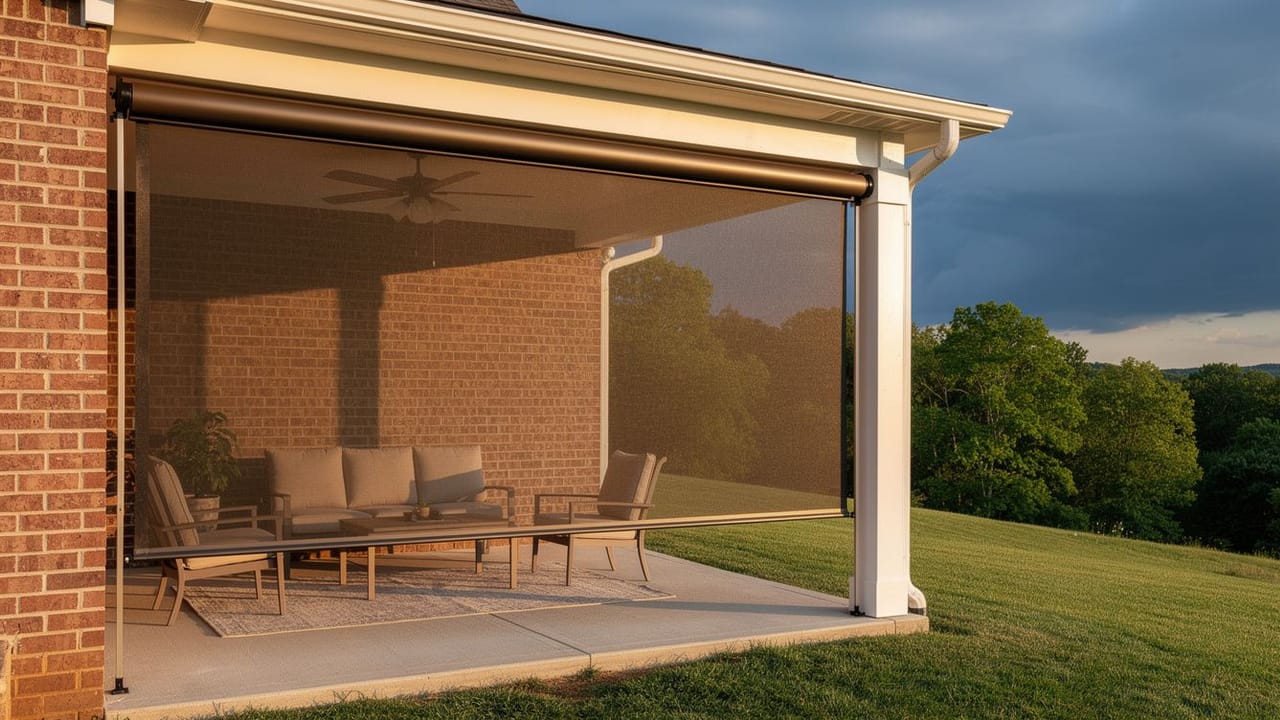
The mesh winds onto a roller tube inside a housing mounted at the top of the opening, and it unrolls straight down when you lower it. Phantom Screens’ retractable screens brochure describes its outdoor motorized screens as retracting vertically, lists mounting options that include its Sure Fit track and cable guides, and offers in-wall, hand-held and mobile remote controls. On our motorized screen work, the housing, the motor and the side tracks are the three parts we plan around.
The sides are what separate one product from another. A track holds the edges of the mesh in a channel on each post so the screen stays tight; a cable guide runs a tensioned wire down each side instead, which is lighter looking and holds the edge less firmly. Loewen’s VistaView sell sheet from 2016 describes a zipper welded to the mesh edges that locks into the track, with the screen retracting on a spring and roll tube rather than a motor.
The mesh itself varies too. Phantom’s brochure says its mesh choices range up to a full privacy block and that its mesh reduces up to 99% of UV rays. A tighter, darker mesh blocks more sun and more view; a light insect mesh keeps the breeze and the sightline. If the porch is meant to stay open most of the year, compare this with a fixed screened room, which our post on a screened porch or sunroom also weighs.
How much wind can a retractable patio screen take?
It depends on the product and how its edges are held, and the only figures available are the makers’ own claims for their own lines. Phantom says in its brochure that its Sure Fit tracks are self-adjusting for tension and capable of operating in winds up to 50 mph. Loewen’s 2016 sheet says the zippered track on its VistaView screens keeps the mesh tight, prevents blowouts and gives the screen a wind rating of 100+ mph, though that product is aimed at large door openings such as lift-slide, multi-slide and bi-fold doors rather than an open patio.
Those two numbers are not a contest between brands. They describe different products, built for different openings, rated by each maker in its own way, and one of the sheets is ten years old. The useful point is that the edge retention decides how a screen behaves in wind: mesh locked into a track holds far better than mesh guided by a cable or hanging free. When we quote a screen, we give you the maker’s datasheet for the exact model and track, so the rating you are relying on is the one for the screen on your house.
When should the screens be rolled up?
Before a thunderstorm reaches the house, whatever the screen’s rating. The National Weather Service’s wind safety page says isolated wind damage is possible when winds are sustained at 40 to 50 mph, and that straight-line winds in strong thunderstorms can exceed 100 mph. A gust front arrives faster than anyone walks out to the patio, and a lowered screen in a storm puts load on the mesh, the tracks and the posts they are fastened to.
Automation helps here. Phantom’s brochure says it works with Somfy motors, including one with obstacle detection, and with weather sensors that adjust the screens on their own, and that the screens can tie into home automation systems. A wind sensor that raises the screen when the air picks up covers the afternoon storm that arrives while nobody is home. We set up the sensor and the motor together and test them before we leave.
Day to day, the screen can stay down in a breeze. The rule we give owners is plain: lower it for bugs and sun, raise it when a storm is forecast or the trees start bending, and never leave it down when you leave town in storm season.
What the opening has to have
A retractable screen needs something solid to hang from and something straight to run down. Phantom lists patios, porches, decks, balconies, pergolas and outdoor kitchens among its uses, and in practice that means a beam or header across the top and posts or walls at each side. A patio cover or pergola gives the housing a place to mount, and an existing covered porch usually has it already.
Size has limits as well. Phantom notes that size limits depend on the ratio of width to height, so a wide, short opening and a tall, narrow one are judged differently, and very wide spans may need a post in the middle. We measure each opening, check the beam and posts for square and strength, and plan where the motor’s wiring comes in before we order anything.
If you are in Sumner County, our pages for Gallatin and Hendersonville cover how we work there. Wherever you are, ask us for a free estimate and we will measure the openings, show you the datasheet for the screen we would use and give you one written price for the screen, the motor and the wiring.
Sources
- Phantom Screens, Retractable Screens brochure (2025) — The maker’s own description of its motorized screens: vertical retraction, Sure Fit and cable-guide mounting, controls, Somfy motors and weather sensors, size limits by width-to-height ratio, mesh UV and privacy claims, and its claim that Sure Fit tracks operate in winds up to 50 mph.
- Loewen, VistaView Retractable Screens sell sheet (2016) — The maker’s 2016 claim that its zippered track prevents blowouts and gives a wind rating of 100+ mph, for screens on lift-slide, multi-slide and bi-fold door openings; spring and roll tube retraction.
- National Weather Service, Wind Safety — Isolated wind damage possible at sustained 40 to 50 mph; thunderstorm straight-line winds can exceed 100 mph.
FAQ
Retractable Patio Screens and Wind in Nashville — questions
How do retractable patio screens work?
The mesh rolls onto a tube inside a housing mounted at the top of the opening and unrolls straight down when lowered. Its edges ride in side tracks or are guided by tensioned cables, and motorized versions run from a wall switch, a hand-held remote or a phone. Some manual versions retract on a spring.
Can retractable screens stay down in a storm or high wind?
We roll them up before a storm. The makers publish their own ratings, such as Phantom’s 50 mph operating claim for its Sure Fit track, but the National Weather Service says thunderstorm straight-line winds can exceed 100 mph. A lowered screen in a gust front loads the mesh, the tracks and the posts.
How do you stop a retractable screen from billowing or coming out of its track?
Hold the edges firmly. A track that locks the mesh edge, such as a zippered or self-tensioning design, keeps the screen tight far better than a cable guide. The track also has to be fastened to straight, solid posts, and the screen should be raised before strong wind rather than left to fight it.
Can a retractable screen run on a wind or sun sensor?
Yes, on motorized systems. Phantom says it pairs its screens with Somfy motors and weather sensors that adjust the screens automatically, and that they can join a home automation system. A wind sensor that raises the screen on its own is the best protection for the storm that arrives while nobody is home.
Can retractable screens go on a covered porch or pergola?
Usually, yes. The housing mounts to a beam or header across the top, and the tracks fasten to posts or walls at each side, so a covered porch or a pergola often has the structure already. We check the beam and posts for strength and square, and very wide spans may need a middle post.