
· by Michael Blair, Nashville's Sunrooms
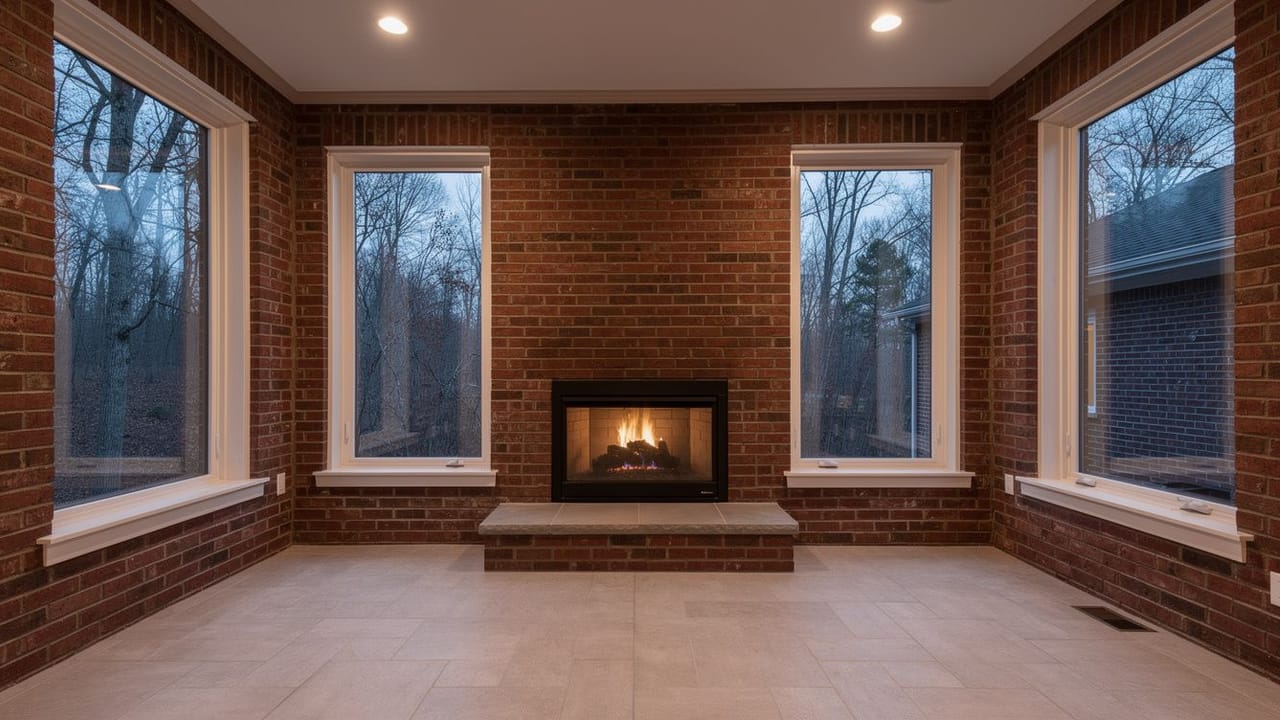
The idea usually arrives in January. The sunroom is the best room in the house from April to October, and someone wants to sit out there with a fire when the windows show frost. It can be done, but a sunroom is not a den with more windows. Its walls are mostly glass, its framing is light, and the one solid wall is often the old back wall of the house. Those facts decide which kind of fireplace fits, where it can sit and how it breathes. A fire only makes sense in a room built to hold heat, so this is a question for a four-season room, not a screened porch with panels. Here is how we think it through before anything is ordered.
Which kind of fireplace a glass room can take
A masonry fireplace, the brick firebox and chimney most people picture, is the hardest fit. It is heavy enough to need its own footing, its chimney has to run up past the roofline, and the code wants clearance between the masonry and any combustible framing around it. A sunroom roof is usually a light structure tied to the house, and a brick chimney punching through it is a large project that changes the whole design. On a new addition planned from the start it is possible. Added to a room that already exists, it rarely is.
A factory-built unit is the usual answer. These are metal fireboxes made to be framed into a wall, and the model residential code has long required that they be installed according to the conditions of their listing and tested to UL 127 (the chimney and fireplace chapter of the 2018 International Residential Code, Tennessee edition). In practice that means the installation manual for the exact model is the rulebook: what it may sit near, what it may sit on, which vent pipe it uses and where that pipe may end outside. When a homeowner asks us whether a unit can go somewhere, our honest first answer is that we read that manual for it.
Among factory-built units, a sealed direct-vent gas fireplace suits a sunroom best. It draws its combustion air from outside and sends its exhaust back out through a pipe, so the fire never uses the air in the room. A wood-burning factory unit needs a tall chimney and a steady supply of air the room may not have, and it leaves ash and smoke in a space full of glass you will be cleaning anyway.
Air in, exhaust out
Every fire needs air. The 2018 code text requires a fireplace to have an exterior air supply for combustion unless the room is mechanically ventilated and kept at neutral or positive pressure, and it says the outside air intake cannot be in a garage or basement and has to be screened with corrosion-resistant mesh. A four-season room is built to be tight. A tight room with an open fire pulling air out of it can end up pulling the exhaust back down instead, which is why the sealed direct-vent design matters so much in a room like this.
That is also where carbon monoxide comes in. The EPA’s page on carbon monoxide lists fireplaces and wood stoves that backdraft, and flues that are the wrong size, blocked, disconnected or leaking, among the ways it gets into a home. The same code chapter does not allow unvented gas log sets unless the system is specifically tested, listed and labeled for that use. In a room where the door to the house usually stands open, the air in the sunroom is the air in the kitchen.
So we plan a carbon monoxide alarm with the fireplace. The Consumer Product Safety Commission’s CO alarm guidance says to put one on each level of the home and outside sleeping areas, test them every month and change the batteries every year. If your house has none near the sunroom, the day the fireplace goes in is the day to fix that.
Where it can actually sit
Wall space is the real limit. A sunroom is mostly window, and a fireplace needs solid framing around it, room behind it for the vent pipe and a clear path for that pipe to reach outside where the manual allows it to end. In most rooms we look at, the one wall that qualifies is the old exterior wall of the house, or a short solid section we design into the new room for this purpose. Adding a fireplace to a sunroom often means giving up a window bay, and it is better to decide that on paper than after the glass is ordered.
The vent termination needs the same care. Where it ends depends on the unit’s listing, and on a sunroom it has to stay clear of the room’s own operable windows and of the house’s doors and windows next to it. The floor matters too. The code wants a hearth extension in front of the opening, and for a factory-built unit that extension has to be easy to tell apart from the rest of the floor. If the room has a raised wood floor rather than a slab, we check what the hearth and the unit will sit on. Our post on what goes under a sunroom covers why that difference matters.
Then there is heat itself. A fireplace aimed across a small room full of glass puts a lot of warmth into a little space, and furniture, curtains and a TV all want to sit right where it shows best. The manual sets the clearances to combustibles and to a mantel, and we follow those figures rather than eyeball them. Many owners pair a fireplace for the look with a ductless system for steady heat and summer cooling, which our post on adding a mini split to a sunroom explains.
Code, permit and what to ask
In Davidson County, the rules come from the codes Metro adopted with local amendments: the 2024 residential code along with the fuel gas, mechanical and energy codes, according to Metro Codes’ adopted codes list. The International Code Council’s announcement of Nashville’s adoption says the 2024 codes took effect on July 16, 2025, and Metro’s own news release covers the same change. Gas piping and venting fall under the fuel gas and mechanical codes, so a gas fireplace is not only a carpentry question. If you are outside Davidson County, the edition your city or county uses may differ, and we check it for your address.
A sunroom already needs a building permit, and the fireplace becomes part of what gets designed and inspected. Our post on permits and setbacks for a sunroom walks through that process. Whoever quotes the job, ask them which unit they plan to use and to show you its installation manual, where the vent will end, where the outside air comes from, what the hearth is made of, and where the nearest CO alarm will be. Clear answers to those questions tell you more than a brochure picture of a fire behind glass.
If you are building a new sunroom and want a fire in it, say so at the start, because it changes the wall plan, the gas line and sometimes the roof. If the room is already built, we can look at whether it has a wall that works. Either way, ask us for a free estimate and we will come look at the room.
Sources
- International Residential Code 2018 (Tennessee), Chapter 10, Chimneys and Fireplaces — Factory-built fireplaces installed per their listing and tested to UL 127; exterior combustion air; hearth extensions; unvented gas logs only when listed for the use; masonry clearances to combustibles. 2018 edition; Metro now uses the 2024 code.
- U.S. EPA, What is carbon monoxide? — Backdrafting fireplaces and wood stoves, unvented gas heaters and faulty flues as indoor carbon monoxide sources.
- U.S. Consumer Product Safety Commission, CO Alarms — CO alarms on each level and outside sleeping areas; test monthly, replace batteries yearly.
- Metro Nashville Codes, Adopted Codes List — The 2024 International Residential, Fuel Gas, Mechanical and Energy Conservation codes adopted with local amendments.
- International Code Council, City of Nashville Strengthens Building Safety by Adopting the 2024 International Codes — The 2024 codes took effect in Nashville and Davidson County on July 16, 2025.
- Metro Nashville Codes, Metro adopts 2024 International Building Codes — Metro’s announcement of the 2024 code adoption.