
· by Michael Blair, Nashville's Sunrooms
A dog that leans on the screen to watch the yard, or a cat that climbs it, will put a hole in ordinary porch screen sooner or later. Pet-resistant screen is the usual answer, and it does what it says, but it is a heavier fabric with trade-offs most people notice only after it is up: less light and air through it, and fewer widths to choose from. Here is what the screen maker publishes about it, and how we use it on the screen rooms we build.
What is pet screen made of?
Pet-resistant screen is vinyl-coated polyester, a heavier fabric than the fiberglass most porches are screened with. Phifer, which makes both, says on its pet protection page that its PetScreen and TuffScreen are both made of strong vinyl-coated polyester, built to limit the tears pets cause by climbing the screen or raking their claws across it. Its PetScreen swatch card calls the product tear and puncture resistant and says it is not harmful to pets.
Ordinary porch screen is woven from glass yarn coated in vinyl, as Phifer describes its fiberglass pool and patio screen, and it is fine on a porch nobody leans on. Resistant is not the same as proof. The maker’s own claim is that PetScreen minimizes damage by dogs and cats, and that is how we describe it too.
Is pet screen worth it over regular screen?
Where an animal touches the screen, yes; across the whole porch, usually not. Phifer’s screen selection guide rates PetScreen best for durability and for pet resistance, but only good for insect protection, airflow and viewing clarity, where several of its other screens rate better or best. The swatch card gives PetScreen an openness factor of roughly 35 to 45 percent and UV blockage of roughly 55 to 65 percent, so well under half of the screen is open to light and air.
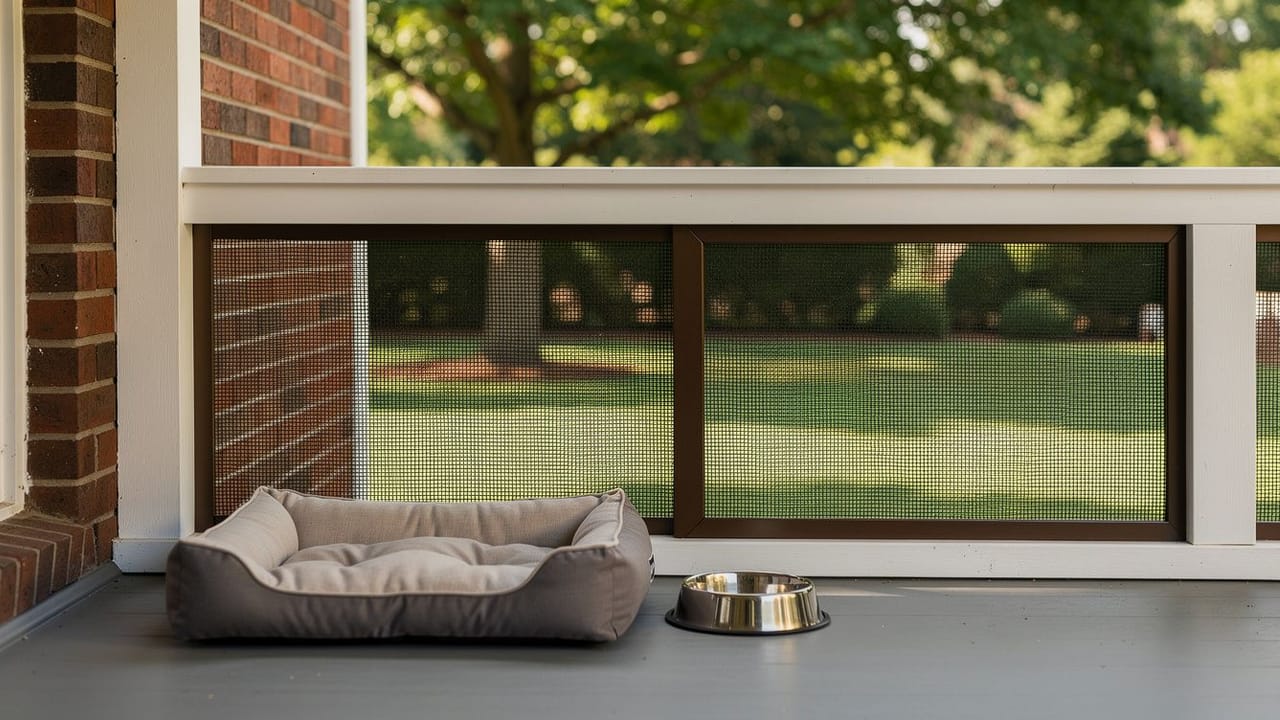
That is a fair trade low on a porch, where a dog leans and a cat starts its climb, and a poor one higher up, where the breeze and the view come through. So on most porches we put pet screen on the panels below the chair rail and a lighter screen above it, and the porch keeps most of its air.
How wide does pet-resistant screen come?
Up to 96 inches, and only in black at that width. Phifer lists PetScreen at 30, 36, 48 and 60 inches in black or gray, and at 72 and 96 inches in black only. Its TuffScreen, the same family of vinyl-coated polyester, comes as wide as 144 inches, and the heavy-duty pool and patio swatch card says it resists damage from pets and suits the wide picture-view openings on screen enclosures.
Width matters on a porch built with tall open bays and no rail, the look many people want for the view. An opening wider than the roll needs a seam, a mullion or a different screen. We plan the framing and the screen together, so a wide bay gets either TuffScreen or a rail that divides it, rather than a seam right where a dog will push.
Cats on a second-story porch
A screened porch above the ground floor deserves more care when a cat uses it. The ASPCA’s advice on high-rise syndrome asks cat owners to fit snug, sturdy screens and warns that cats in one- and two-story buildings are still at risk from a fall. On an upper porch we run pet screen at least from the floor to the rail, check that every spline is seated tight in its channel, and leave no gap at the door a cat can push through.
We screen porches and patios around Brentwood and across Middle Tennessee, and a porch that is already screened can usually be rescreened in pet screen without rebuilding the frame. If biting midges are the other problem, our post on no-see-um screen covers the finer meshes. Tell us about the porch and the animal, and we will suggest where each screen goes.
Sources
- Phifer, Pet Protection screening — PetScreen and TuffScreen are vinyl-coated polyester, made to limit tears from pets climbing or clawing the screen
- Phifer, PetScreen swatch card (V25) — Tear and puncture resistant, not harmful to pets, minimizes damage by dogs and cats; widths 30 to 60 inches in black or gray, 72 and 96 inches black only; openness about 35 to 45 percent; UV blockage about 55 to 65 percent
- Phifer, Screen Selection Guide (V22) — PetScreen rated best for durability and pet resistance, good for insect protection, airflow and viewing clarity
- Phifer, Heavy-Duty Screen for Pool and Patio Enclosures swatch card (V25) — TuffScreen vinyl-coated polyester resists damage from pets, widths to 144 inches, suited to wide picture-view openings
- Phifer, Phiferglass Insect Screen for Pool and Patio Enclosures swatch card (V25) — Standard porch screen woven from glass yarn coated with vinyl
- ASPCA, High-Rise Syndrome: Lifesaving Tips for Cat Parents — Snug, sturdy screens; cats in one- and two-story buildings still at risk
FAQ
Pet Screen for a Screened Porch: Where It Goes — questions
Can a dog tear through pet screen?
It is much harder than with ordinary screen, but not impossible. Phifer, which makes PetScreen, calls it tear and puncture resistant and says it minimizes damage by dogs and cats, not that it prevents all of it. We stretch it taut, seat the spline firmly, and look again at any panel a dog favors.
What is the difference between pet screen and regular screen?
Regular porch screen is vinyl-coated fiberglass; pet screen is vinyl-coated polyester, a heavier fabric made to resist claws and paws. Phifer’s selection guide rates PetScreen best for durability and pet resistance but only good for airflow and viewing clarity, and its swatch card puts the openness at roughly 35 to 45 percent.
Does pet-resistant screen block the view?
Somewhat. Phifer rates PetScreen good, not better or best, for viewing clarity, though it says the screen gives good outward visibility. With roughly 35 to 45 percent openness, less light comes through than with the lighter screens. Using it only below the chair rail keeps the view at seated eye level mostly through the lighter screen.
Can you use pet screen on just the bottom of a porch?
Yes, and on most porches that is where we put it: on the panels below the chair rail, where a dog leans and a cat starts to climb, with a lighter screen above. Phifer rates PetScreen only good for airflow and viewing clarity, so keeping it low lets the upper panels carry the breeze and the view.
Is pet screen safe for cats?
Phifer says PetScreen is not harmful to pets. The bigger safety question is a porch above the ground floor: the ASPCA asks cat owners for snug, sturdy screens and warns that falls from one- and two-story buildings still injure cats. On an upper porch we run pet screen from the floor to the rail and seal the door gap.